


Deload weeks
A deload is a planned easy stretch of training so fatigue can clear and you come back ready to push again.
Definition
An international panel of strength and physique coaches agreed on this definition in a 2023 consensus study: "Deloading is a period of reduced training stress designed to mitigate physiological and psychological fatigue, promote recovery, and enhance preparedness for subsequent training."
How coaches deload
In interviews with 18 experienced coaches (Bell and colleagues, 2022) there was no single method. The most common changes were:
- Less volume: fewer sets per session and fewer reps per set.
- Less effort: stopping further from failure and/or using lighter loads.
- Different exercises or set structures.
Deloads typically lasted 5 to 7 days and were programmed every 4 to 6 weeks, although timing varied a lot between coaches.
Keep your usual exercises and weights, cut the number of sets roughly in half, and stop every set with a few reps in reserve (around RPE 6 to 7). Return to normal training the next week.
What the research says
Research on deloading is still thin; much of what we know comes from coaches' experience. One controlled trial (Coleman and colleagues, 2024) compared a full week off at the midpoint of a 9-week program with training straight through. The week off made no difference to muscle growth, power or muscular endurance, but the group that kept training gained more lower-body strength. That was a week of no training, not a reduced week, so it does not settle how a typical deload compares.
Signs you might need one
- Your main lifts have stalled or gone backward for a couple of weeks despite good sleep and food.
- Usual warm-up weights feel heavy, or your RPE keeps climbing at the same weights.
- You are dreading sessions you normally enjoy, or joints are nagging.
A log makes this obvious: see how to log your workouts and progressive overload.
See when your training dips
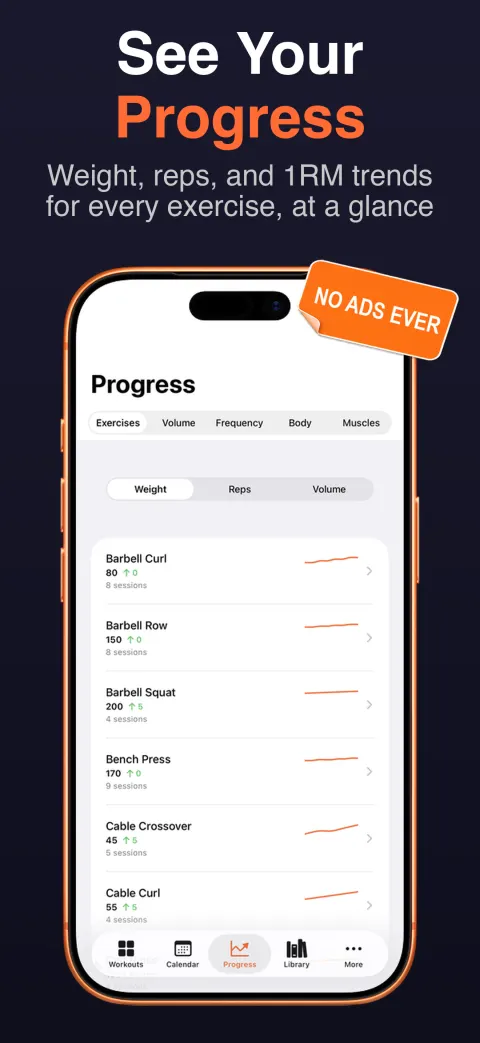
Lift Pro charts every lift, shows volume week by week, and flags significant drops in training volume.


Frequently asked questions
How often should I deload?
There is no single rule. Coaches interviewed by Bell and colleagues (2022) typically programmed a 5 to 7 day deload every 4 to 6 weeks, but said the timing varied widely. Many lifters deload when performance stalls or fatigue builds instead of on a fixed schedule.
Should I stop training completely during a deload?
Usually not. Most coaches reduce sets, reps or effort rather than stopping. In a 2024 trial, a week of no training at the midpoint of a 9-week program led to smaller lower-body strength gains than training straight through, with no difference in muscle growth.
Will I lose muscle in a deload week?
A week of reduced training is short. In the 2024 PeerJ trial, even a full week off did not change muscle growth compared with continuous training.
Can an app tell me when to deload?
Lift Pro flags significant drops in your weekly training volume, and its charts show when your lifts stop moving, which helps you decide. It does not prescribe deloads automatically.
Sources
- Bell L, et al. Integrating deloading into strength and physique sports training programmes: an international Delphi consensus approach. Sports Med Open 2023;9:87
- Bell L, et al. Coaches' perceptions, practices and experiences of deloading in strength and physique sports. Front Sports Act Living 2022;4:1073223
- Coleman M, et al. Gaining more from doing less? The effects of a one-week deload period during supervised resistance training on muscular adaptations. PeerJ 2024;12:e16777